
Who are hijras and how does the third gender live in India?

Slowly, standing side by side in a golden tent, on a throne made in their home, surrounded by offerings from the crowd, the hijra blesses them. Making sarfi with members of the lower caste, the untouchables, is considered an honorable and joyful event in many families.
Contents of the article:
People bring their newborn children to them and come for wise advice and signs of good luck so that they will remain healthy throughout their lives. This custom is simultaneously one of the oldest and most controversial in India.
After the hijras gained great power, they began to be considered demigods, as well as humans! Today, most communities acquire goods and live off donations from parishioners and alms.
Who are hijras?
Lakshmi Narayan Tripathi is one of the most famous hijras in all of India. Hundreds of people, wishing to touch “God,” come to touch her from the second row of her tent. The easiest way to do this is at the major pilgrimage festival, Kumbh Mela, which attracts people from all over India of various religious affiliations.
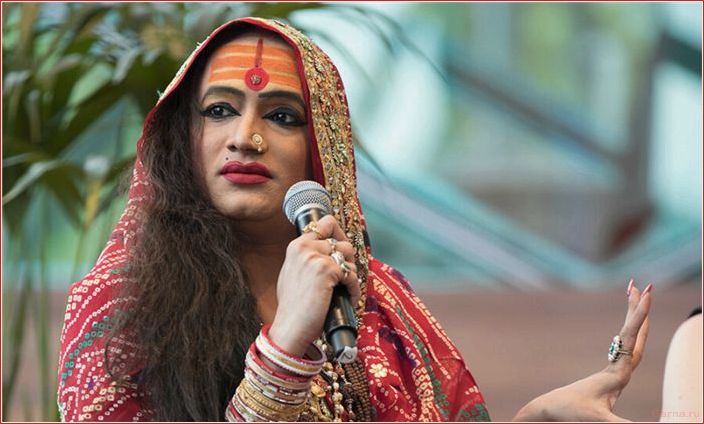
Lakshminarayan Tripathi.

Listening very attentively to everyone who approaches her, Lakshmi first helps with kind words. She asks people not to worry, not to succumb to the process of life, not to panic, and not to reduce their karma, but simply to calmly resolve their problems. Hijras—members of the third gender—are considered sacred in this country. They are worshipped as idols, falling at their feet and kissing the hem of their richly embellished saris. A handful of rice from a hijra, a chewed rice wrapper, and a wish for good luck practically guarantee success and happiness in life for the average Indian. These pilgrims seek various advice: how to regain their appetite, how to heal a sore leg, how to live happily with their husbands, how to solve financial problems.
In Pakistan, Nepal, and Bangladesh, as well as throughout the country, there are approximately half a million transgender people, to whom the “Hijra” refers with considerable reservations. Not all men who identify as women are suitable for the role of hijra. To become a pilgrim, venerated by devotees, one must undergo a lengthy period of religious formation.
How did hijras emerge?

How did hijras appear?
Their primary patron is Shiva, who is often depicted in cultural sources and paintings with the organs and characteristics of both sexes. One of his incarnations, Bhacchara Mata, is the goddess of female attire, associated not only with birth and chastity, but also with the third gender.

It is believed that hundreds of years ago, Bhacchara Mata was a girl of the highest caste, a girl who was raped by bandits. When they abandoned her body, Bhacchara grabbed a dagger and cut off both her breasts to gain the power of a curse she intended to bestow upon the criminals. Having performed this ritual, this tragic act, she shouted to the leader of the bandits that he would be helpless unless a temple was built on the same site where men could come dressed as women and pray to her. Thus was born the cult of the hijras, but this is not the only version held by these religious figures.

According to one legend, Krishna, considered the progenitor of all gods in Hinduism, married a man whose feminine appearance was considered fatal. According to another, the hijra was the result of the union of the goddess Lakshmi and her husband Vishnu.
Information about them can also be found in the Ramayana. According to legend, Rama, sent from his own kingdom to wander the forests for 14 years, carried off many of his subjects. He did not want the people to suffer, so he addressed all men and women, ordering them to return to their homes.
The only ones who disobeyed him were the hijras. This was because they belonged to neither gender. Impressed by the devotion of his people, Rama granted them the right not only to perform as artists but also to bless people at weddings, birthdays, and other important occasions.
The ritual supernatural powers of the Hijras are so deeply ingrained in mythology that many people still greatly fear being cursed and lack cosmic powers.
The Brilliance and Poverty of the Hijras
Read in society centuries ago, these transgender women occupied a very important position in the social hierarchy.

The splendor and poverty of hijras
Read also:
How do you get married in India?
Every country has customs and traditions related to marriage. India is, of course, no exception. Moreover, India is a wedding country Thus, the hijras, distinguished by great intelligence and learning abilities, became not only close associates of the Sultan, but also politicians, warriors, lawyers, administrators and even advisers to generals
For the hijirs, whose caste is considered low in India, this period was one of prosperity. This was due to the fact that they did not have as much power in their hands.
After the arrival of the British in Hindustan, the hijras were forced to go underground. Faced with such an unusual phenomenon as the Victorians, the British mentality could not allow them to coexist with ordinary people. Hijras were driven out of their homes and accused of prostitution, seducing and castrating young boys.
Transgender and intersex people were inherited, criminalized and disenfranchised through strict bans, executions and trials, which began to eradicate them from the public consciousness.
For a long time nothing was known about them. The hijras wandered in remote areas, enjoying their popularity only among the population who still believed in their magical abilities. After wandering and wandering for many years, they gradually returned to a normal lifestyle, but were unable to regain their former greatness.
What do hijras do now?

In addition to being followers, communicating with them and organizing rituals, hijras are also famous artists. Dressed in women”s clothing and painted in feminine colors, they are very colorful guests at any holiday.
What are hijras doing now?
Acting as a kind of toastmaster, hijras not only entertain guests, but also bless those getting married with the birth of sons. Even though their clothing, makeup, and demeanor are of the opposite sex, they try to bring in masculine energy. at such moments.
Prostitution is also considered a common occupation among hijras. Transgender people who do not experience sexual attraction to women are aimed at the male population, which willingly uses the services of “demigoddesses.” Their community has been repeatedly involved in fraud and drug trafficking.
Third gender: how transgender people live in India [18+] | citizens 2. 0
The dual nature of hijras allows them to be law-abiding, engage in immoral behavior, and not allow anyone to control them.
Life and customs of hijras

The life and customs of hijras
The guru may prohibit devotees from leaving gifts, force them to do housework, or even force them into prostitution. Hijras cannot disobey, otherwise they will be expelled from the commune. At the same time, firstly, the guru is a protector who saves a young man from a cruel world in which even his family has turned against him.
Becoming part of a community does not simply involve expressing a desire to be transgender or intersex. You have to go through a long path of religious formation, rituals and tests, which can last from several months to several years. The Guru decides who will be accepted by the community and who will not. This strict selection leads to the fact that the streets of the slums are filled with men who wear women”s clothing simply for the sake of profit.
The castration process is also an important part of becoming a hijra and is not a solution for everyone. It is not performed by a surgeon and never under sterile conditions. Men can”t even stop bleeding after having their genitals removed. It is believed that all past sins and life events are washed away with blood.
For dozens of days he cannot leave his room and suffers from religious deprivation. This type of ritual is prohibited by Indian courts, so everything happens underground.
This is a display of cut off genitals as a way of cursing people.

Godlike communities are small, with populations ranging from five to 15 people.
Hijras and legislation
Previously, many of these practices were considered illegal, but the gradual legalization of hijras began in 2014, when the existence of a third gender was recognized at the legislative level. At this point, all transgender people received constitutional rights. Much of this is due to people like Lakshmi Narayan Tripathi, who actively fought for all members of the LGBT community.
Hijras and legislation
In 2016, the Indian government tried to introduce a bill to protect the rights of transgender people. This prohibited not only begging, but also self-identification as transgender. Instead, a special committee was supposed to verify a person”s gender identity, but due to very strong opposition from society, including the hijra community, this bill was withdrawn from consideration.
In 2018, a legendary event occurred. Homosexuality is no longer a crime in India and hijras have more opportunities to be open.
However, laws enacted against transgender people punish crimes against them much less than laws against women who belong to the same sex at birth. The process of identity change has also become more complex. Now you need to get a full list of permits to reach the official level.

Discrimination and inequality are what these people face today.
“third gender” in India: all the secrets of the mysterious hijra caste!
Hijri, lives, third, india


